Saturday, November 19, 2005

Creativity technique: ZOA - Zone Of Attention

About this post

Type of technique: attention directing tool

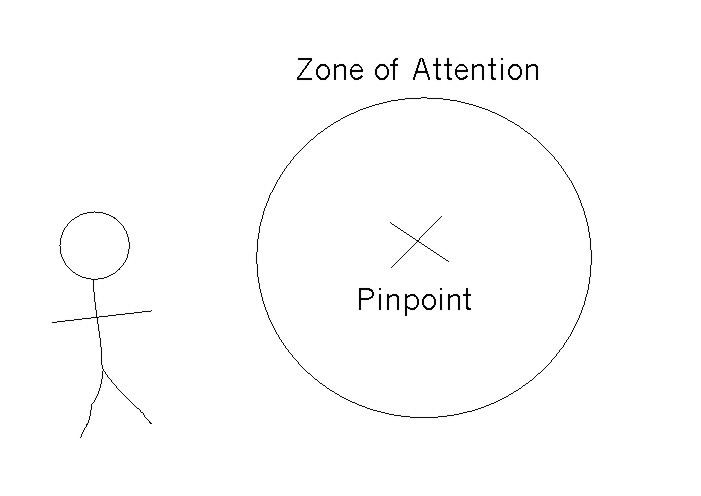
Technique in a nutshell: imagine you have a three dimensional sphere that you can move around in space. This represents your attention during creative thinking. You can 'zoom in' on objects within the sphere.

Applying the Zone of Attention Zone of Attention

To apply the Zone of Attention technique, I imagine a transparent three-dimensional sphere in front of me. This represents my area of attention during creative thinking. The Zone of Attention also has a pinpoint to fine tune my focusing. I can visualise a Zone of Attention either on something I can directly see, or on a scene that I am visualising or recalling.

Actions on the Zone of Attention

I can carry out three changes on the Zone of Attention:

I can move the ZOA anywhere.
I can change the size of the ZOA.
I can move the Pinpoint within the ZOA.

Varying the size of the ZOA

I use the acronym WUMPP to remind me of my options when changing the size of the ZOA:

W = World
U = Universe
M = Mile
P = Person
P = Pinhead

I can, of course, change the ZOA to any size I like but the acronym helps me to remember (and use) the full extent of the sizing options.

Naming the Zone of Attention

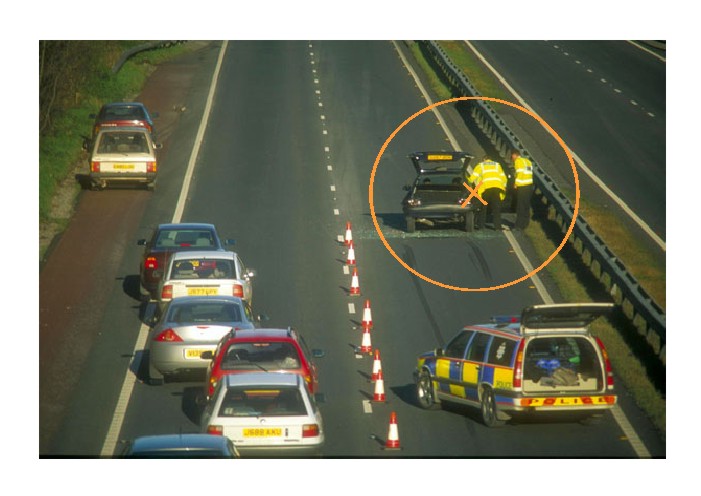
(c) FreeFoto.comI can give the Zone of Attention a name. This helps when listing information about the contents of the ZOA and helps to avoid listing only the most obvious features within the zone. It also allows the ZOA to be considered as a concept in its own right. So if I am imagining an accident scene such as the one on the right I could name my chosen ZOA 'the accident zone'.


Including myself in the Zone of AttentionNow Here Me Doing: Brainstorming


At the start of any creative exercise I find it's a good idea to include myself in the initial Zone of Attention. This helps me to bring my awareness into the here-and-now and consider what my initial goals are during the creativity.

In words this present-moment awareness could be expressed as:

Now Here Me Doing: Brainstorming

or

Now Here Me Doing: Problem-solving

etc.

See also:

Book: Serious Creativity, Edward de Bono

Saturday, October 08, 2005

Pre-listing using Google images.

About this post

Use when: you want to name examples of a subject

Example: you want to list types of transport. You look at a Google image and pick something from the image (example: a hill). You then give this word an adjectival function that modifies 'transport': hill transport. This suggests: sledge, tram, cable car, skateboard etc.

Pre-listing using Google Images

Pre-listing is used to name and list examples of a particular subject.

My obejctive in this example - with the subject 'police' - is to name as many types of police as possible, including types, names, categories, specific examples etc.

Example of pre-listing results for 'police':

Short police, bad police, high-ranking police, local police, London police, new police, potential police, ex police, retired police, dead police, original police, dog-handling police, human police, traffic police, etc.

If I choose to I can be more specific with each example given. For example:

Original police = Peelers
High-ranking police = Sir Ian Blair

or I can use the listed information in combination to make new examples:

Dog-handling London police
Local bad police

I can consider that the impossible ideal is 'name ALL police possible', obviously an ideal I could spend the rest of my life pursuing! I want to make the listing create obvious and non obvious options. I can do this with pre-listing using Google images.

Pre-listing using Google images

With this image:
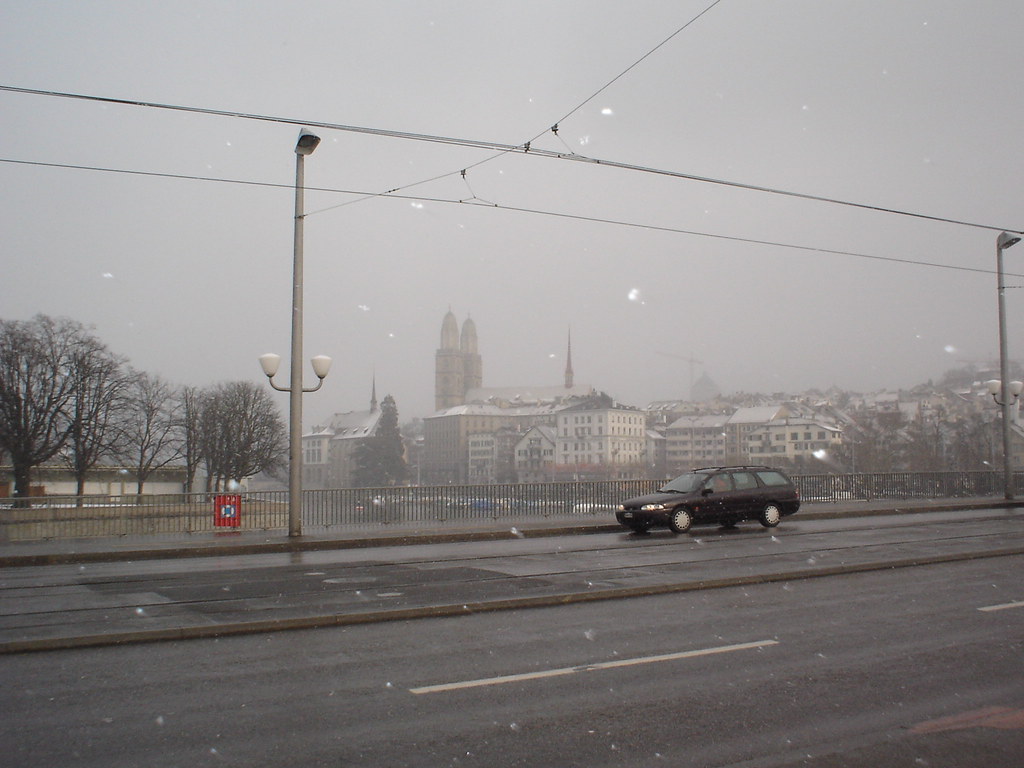

I simply pick out something I see in the image:

Car

and then that word takes an adjectival function to modify 'police':

Car police

'Car police' is the first item on the list, but I can also use 'car police' to trigger more specific examples, or I can interpret it. I find it's a good idea to set a quota (say five) to both list the obvious and then go beyond the obvious:

Car police = Transport police
Car police = Police trained to drive fast
Car police = Police who investigate car theft
Car police = Police who get to work by car
Car police = Police officers who are car enthusiasts

I can also step up the concept level or describe the car:

Concept level: Car = vehicle
Description: Car = pollutant

and then use 'vehicle' and 'pollutant' as trigger words, with the quota of five again.

Word triggers

I like to use the letters of listed words as word triggers. So with words listed above such as:

Car, vehicle, pollutant

I take the first three letters: car, veh, pol, and use them to trigger more words. I try to list words of one syllable, two syllables and over. For example:

Carpet, carnage, caramel

Vehement

Polite, political, polished, Polish

and then again use these (often with a quota of five) to list further examples.

For example:

Carnage police = police who have been involved in pile-ups, police who investigate crashes, police who have caused accidents, etc.

With a 'difficult' word such as 'caramel' I still try to complete the quota of five, although more thinking is often needed to complete the connection!

Caramel police = police who investigate food standards, police who like caramel (!), police who are 'sweet', police who have caramel for lunch, police with the surname 'caramel' etc

Seeing beyond the obvious choices

I cannot resist the temptation to stretch my thinking beyond the obvious when choosing elements of the Google image and completing my list!

With the same image used above:

I pick out an object (say, the car again, for this example) and then describe it with an adjective (or a word that has a modifying function). For example:

Car = black

Then, with another image such as:

I set a directive using the modifying word from the first image. Thus: "Name something black".

Two obvious possibilities here are: the writing, the drawing.

"Writing" and "drawing" now become my modifying words:

Writing police

Drawing police

Again I can set quotas at each stage. In answer to the directive "Name something black" I could have forced myself to list five black things in the picture. Also with any listing I can name five further examples triggered. For example:

Writing police = police who've written books, police who write for papers, John Stalker (who seems to be 'rent-an-opinion' when police matters are discussed in the media!), police who enjoy paperwork, police who have taken admin positions due to being injured on the job, etc.

Random images

I find the images using Google image search. For the search subject I simply use a random letter and random number in combination, such as "c 77".

Conclusion

It's obvious that this nice bag of tricks produces some disparate focuses. Also what I like about these approaches is that they uncover assumptions you would make when listing purely from memory: if you were listing police would you think of listing the dogs as members of the police? Would you think of listing people who impersonate police officers? Would you think of listing fictional officers? Tazmanian officers? The approaches above help to create a sizeable chunk of that impossible ideal of 'list everything possible'.
Monday, August 08, 2005

A strategy to find assumptions

About this post

Type of technique: assumption finding

Technique in a nutshell: Say you want to list assumptions about the moon, for example. You can set a directive 'name assumptions about the moon'. But you can also modify that directive with set words (such as time, place, person). Thus: 'Name person assumptions about the moon'. Possible answers: we assume only people have visited the moon, we assume that people have gone to the moon.

A Strategy to Find Assumptions

I've been using this approach to help find assumptions.

Imagine a bomb-damaged tree at an old WWII air base - such as Biggin Hill. A number of assumptions are automatically made about the bomb-damaged tree. In the search for assumptions a directive such as:

List assumptions about the bomb-damaged tree

can be made. However, this can be modified using the category headings:

Time (duration) Place (area) Thing (object) Person Doing (Activity) Being (Is) Having (Has) Saying (utterance) Knowledge

If I select 'time' from the category headings I can rewrite the directive thus:

List time-assumptions about the bomb-damaged tree

I reckon that my first time-assumption is that the bomb damage occured during WWII. Maybe the damage could have occured at some other time?

If I select the 'duration' part of the category I make the directive:

List duration-assumptions about the bomb-damaged tree

Which makes me realise I assume the damage occured at one time. Maybe the tree could have been damaged on more than one occasion in the war or whenever.

Using 'person(s)' gives the directive:

List person(s)-assumptions about the bomb-damaged tree

which makes me realise I'd assumed the damage was caused by German bombers. Maybe the tree could have been damaged by a plane colliding with it and detonating its bombs etc.

Saturday, August 06, 2005

IF-forcing

About this post

Type of technique: breaking rules and forming thought experiments

Technique in a nutshell: write a simple fact about something. Example: cows produce milk. Then force a conditional aspect using 'if': cows produce milk IF they are alive. Experiment with replacement for the 'alive': dead, elderly, male etc.

If-forcing

I've been finding that this IF-forcing approach can lead to ideas. Especially simple ideas. I start by writing down a fact about the subject and then working out how the fact is conditional by using 'if'.

So, for example, with subject 'gun' I write down a fact about a gun:

a gun fires.

Using 'if' to find the conditional aspect gives:

A gun fires if you pull the trigger.

Then I can play about with the condition or parts of the condition. I can remove the subsequent part of the sentence giving:

A gun fires if...

and then consider alternatives such as:

A gun fires if you breathe onto it
A gun fires if you hold it above your head
A gun fires if you point it towards yourself

That last one is an interesting concept for fiction. A gun could be made in a way that makes a bullet fly in the opposite direction. So the 'baddie' can put the gun in their mouth to look as though they are about to shoot themselves when really the bullet will fly in the normal direction.

I can keep the sentence as it stands:

A gun fires if you pull the trigger

and opt to change just one word:

A gun fires if you pull TWO triggers.

Which would be a more secure gun.

It's worth writing down as many conditional aspects as possible:

A gun fires if it is loaded
A gun fires if it has a barrel
A gun fires if it works
A gun fires if you are carrying one in the first place
A gun fires if you have fingers
A gun fires if the bullet is live

It's quite a simple yet effective method for finding assumptions.

Friday, July 01, 2005

Problem solving and a creativity technique: multiple redefinition

I like this multiple redefinition technique I found over at Mycoted's library of creativity techniques. I've been using it to redefine my project for automatic fiction.

Open-ended problems by definition are not well defined ‘the boundaries are fuzzy’

The following checklist of provocative statements is suggested:


- ‘There is usually more than one-way of looking at problems. You could also define this one as ….’

- '….but the main point of the problem is….’

- ‘What I would really like to do is….’

- ‘If I could break all laws of reality (physical, social etc.) I would try to solve it by ….’

- ‘The problem put in another way could be likened to …’

- ‘Another, even stranger, way of looking at it might be….’

The full details of the technique are over at Mycoted.

Friday, June 24, 2005

Using pre-listing to find assumptions

The pre-listing method can be used to help find assumptions about a subject. If I am looking for assumptions about a particular subject (the Wimbledon tournament, for example), the assumption search could be expressed as the following directive:

List assumptions about Wimbledon

If I convert this to pre-listing format it now reads:

List X-assumptions about Wimbledon

Then I can specify the 'X' by using a word from pangram trigger, directed-association or flip-flop directed-association. If the word chosen is 'end', for example, then the final directive is thus:

List end-assumptions about Wimbledon

What does this suggest? There is the assumption that the tournament will end. Or an 'end-assumption' could be a different category of assumption - perhaps the very last assumption that someone would consider - something unrelated to tennis. (the first assumption about Wimbledon would probably be that it's a tennis tournament.) There is the assumption that the tournament venue has an end (the boundary of the venue). An assumption that the games end. An assumption that players shake hands at the end etc. One pre-listing directive can suggest a lot of possibilities.

The ten percent method

The ten percent method is a simple method for creating ideas.

Information about a subject can be listed using the strategies in the profiling subjects, pangram trigger profiling and category headings/pre-listing posts. The information can be pluralised (if not already a plural) and the ten percent method applied.

Using the ten percent method

This explanation will use the information listed (from both key terms and the main body of information) about the Wimbledon tournament. The template for the idea generation is:

10 % of X is X

so if I use the listed information 'ballboys/ballgirls' the completed template will be:

10 % of ballboys/girls are X

For the 'X' I can systematically insert one of the nine category headings. Which gives:

10 % of ballboys/girls are TIME ballboys/girls
10 % of ballboys/girls are PLACE ballboys/girls
10 % of ballboys/girls are THING ballboys/girls
10 % of ballboys/girls are PERSON ballboys/girls
10 % of ballboys/girls are DOING ballboys/girls
10 % of ballboys/girls are BEING ballboys/girls
10 % of ballboys/girls are HAVING ballboys/girls
10 % of ballboys/girls are SAYING ballboys/girls
10 % of ballboys/girls are KNOWLEGE ballboys/girls

I can run through these (and the template: '10 % of ballboys/girls are X') and see if any ideas immediately come to light.

Using the original template '10% of ballboys/girls are X' I reached an immediate idea - that ten percent of the ballboys/girls would be chosen by nationwide ballot or competition. (As it stands I believe the ballboys/girls are selected from local schools.) I'm sure many young people would jump at the chance to do the job.

With '10 % of ballboys/girls are TIME ballboys/girls' I wondered if they could use ballboys/girls from another time. Maybe they could use young people who did the job at other tournaments? Or maybe there could be a kind of exchange system where ballboys/girls from tournaments around the world are given the chance to work at other international tournaments.

In addition to using the nine category headings for 'X' I can use any word/concept produced using directed-association, flip-flop directed-association or pangram trigger.

With the template:

10% of tournament ends are X

I selected the word 'to' to give:

10% of tournament ends are TO

Which made me think there could be a big party off site at the end (that players would go TO) or maybe all competitors from the tournament could run on the court at the end like the competitors at the end of the Olympics?

Other ideas

10% of wimbledon tournaments are X

I converted to:

10% of Wimbledon tournaments are TIME

I chose a time - autumn - and considered what '10% of Wimbledon tournaments are autumn' suggested. This led to an interesting idea - that during the Olympics the Wimbledon tournament could fuse with the Olympics tennis tournament. There have been some problems with the lack of interest in the Olympics tennis tournament. Perhaps this could provide a spur?
10% of Wimbledon courts are CLAY

Perhaps not a good idea in itself, but maybe the winner of Wimbledon could play the winner of another tournament in a match over two legs - one on grass and one on clay.

10% of crowds are X

Reminded me of this idea: A section of seats in TV studio audiences auctioned for charity projects

Perhaps a similar arrangement could be done at the final and other popular games?

10% of finals are X

The doubles finals are around the same time as the singles finals. Perhaps the doubles tournament could take place at another time in the summer. This would attract the top stars as they would not be concerned with their involvement in the doubles jeopardizing their singles chances.

10% of autographs are X

Players sign autographs for fans after the game. There could be an autograph tent where the public can go to meet the players and get autographs, or there could be a shop selling autographed items such as balls and photographs of players in action.

10% of dew that falls onto court overnight is X

I thought the dew could be bottled-up and sold off. A daft idea, but things such as the nets (or even the court) could be auctioned off after the event in a grand auction.

10% of fast serves are X

I used the category heading to give: "10% of fast serves are person" which gave me the idea that there could be an arrangement at the Wimbledon site where the public can serve a ball and have their service speed measured. There could be a competition for the fastest in different categories.

10% of trophies are X

Similar to the World Cup there could be a trophy kept by any player who wins the competition three times.

10% of tickets are X

There could be a cheaper ticket that enables the spectator to view only the practice courts or less popular games. (They may already do this perhaps).

Thursday, June 23, 2005

Another profiling strategy: category headings with pre-listing

When information about a subject is listed what are the main categories that any listed facts will belong to? I use the following category headings:

Time (duration) Place (area) Thing (object) Person Doing (Activity) Being (Is) Having (Has) Saying (utterance) Knowledge

These category headings can be used to list key information. So, if the subject is 'Wimbledon tournament' I can choose the category heading 'place' and form a directive:

"Name Wimbledon people"

and then list people involved in the Wimbledon tournament:

Players, spectators, umpires, TV presenters, ticket sellers, refreshment providers, cleaners, ballboys/girls, judges, royals, photographers etc.

Or I could have set the directives "Name Wimbledon time", "Name Wimbledon place", "Name Wimbledon object" etc.

Use of pre-listing

I can fine-tune my search by using pre-listing. I will choose a word using pangram trigger - 'bank' - for example then choose one of the category headings - 'place' - for example and then state a directive: "Name Wimbledon bank-place". Which could suggest:

1) Henman Hill
2) The place where the trophies are stored
3) Cashpoints available for spectators

More examples

With pangram trigger word 'wit' and category heading 'time'
Directive = "Name a wit-time at Wimbledon"

1) When players make jokes
2) Exhibition/practice matches
3) Laughter in the crowd (Mexican wave?)

Trigger: 'crew'. Category: 'person'
Directive = 'Name a crew-person at Wimbledon'

1) The boss of the ballboys/girls
2) Coach parties
3) Head of refreshments

Trigger: 'see'. Category: Utterance
Directive = 'Name a see-utterance at Wimbledon'

1) "Did you see that great shot"
2) "What players did you see at Wimbledon today?"
3) "You can't see the ball because the serve is so fast"

My prefered method

I prefer to choose one category heading and list a number of words generated by pangram trigger.

So with category heading 'place' and a list of words:

big, at, chip, clot, see, ma, rent

I will use the directive template "Name X-place at Wimbledon" and choose the first random word to complete the directive "Name big-place at Wimbledon" and attempt to list three facts:

1) Big-place = centre court
2) The whole venue
3) The bar (apparently a big priority for some visitors)

Then set the next directive: "Name at-place at Wimbledon" etc.

Profiling a subject with the pangram trigger

The pangram trigger can be used to help profile a subject.

The pangram trigger is used to suggest random words that can be used as triggers to help list facts/associations about a chosen subject. It is primarily used to suggest short words (or two, three or four letters) but longer words can also be considered and used in profiling the subject.

As discussed in the pangram trigger post, I use the pangram:

The quick brown fox jumps over the lazy dog

(A listing of A to Z can be used, but I prefer the pangram above as it leads to a more random choice of letter selection)

and pick a couple of random letters. For example, D and E.

If the two letters form a word I will select that as the word to use for profiling. If not then I add another letter. For example, W. Which obviously forms a usuable word, 'dew'.

This word is then used to list facts in answer to the directive:

"What facts/associations are suggested about Wimbledon tournament by the word 'dew'?"

Wimbledon dew
1) The dew that falls onto the courts/site over night.
2) The moisture (humidity) in the air
3) Sweat

As described in the profiling subjects post, I will allow some interpretation but I also attempt to interpret the word literally.

A number of three letter words would have been possible withe the D and E such as:

Deb, def, del, den, der, des

but the D and E could also have been used to trigger longer words, such as:

Dean, deacon, debutante, debut, declaration, deceased, dealt, decision, deport, depot, demure etc ad infinitum

All of these can be used to find facts/associations with the subject.

So with 'Wimbledon tournament' as the subject and various words formed using the pangram trigger, here are some examples of associations/facts I reached:

Wimbledon tournament: trigger word = bed

1) Officials who stay there over night
2) The foundations of the courts/site
3) The end of the tournament

(As described in the profiling subjects post I try to make three associations although a quota of ten could be set.)

Trigger word = pan

1) The pans used to cook food
2) The panning (criticism) of players
3) 'panning for gold' - looking for the stars of the future (a lot of interpretation there!)

Trigger word = wise

1) People in crowd who are very knowledgeable
2) The players' coaches
3) The umpires

Trigger word = soak

1) Baths/showers used by players
2) Rain
3) Saturation media coverage

Trigger word = ex

1) Ex stars
2) Past tournaments
3) Players past relationships

Trigger word = to

1) How people get to the site
2) Where the tournament is going (long term plans etc)
3) The journey of the players from their hotels etc

Trigger word = run

1) Players running during games (I wonder what distance a player actually runs during an average game?)
2) Unbeaten runs
3) The longevity of the tournament

Wednesday, June 22, 2005

Profiling a subject

When profiling a subject the aim is to create a huge list of facts about a particular subject. I can then choose any of these facts for further creative attention. Quite often the mere act of directing attention to a fact is enough to generate an idea.

Finding/choosing a subject

If I'm starting out from scratch with a blank page I can peruse the directed-association results to see if there are any subjects of interest I'd like to profile. But, as it's Wimbledon fortnight, I'll choose 'Wimbledon tournament' as my subject.

Use of random words/concepts and directive

When profiling a subject I use random words and concepts from directed-association results. Instead of using the random words to suggest new ideas (as in De Bono's random word technique) I use them to trigger associations. As a directive, this would be worded as:

"What association/fact does this random word/concept suggest?"

Example of profiling using 'Wimbledon tournament' example.

So with 'Wimbledon tournament' as my subject I pick a random word/concept from this blog's example of directed-association results.

Word/concept = debate
Which initially suggests times when a player disagrees with the umpire's decision.

I try to get three associations/facts from each word so that I don't fall into the trap of stating only the obvious. There certainly wouldn't be any harm in setting a quota as high as ten though.

Second and third associations for 'debate':

2) Discussions on who will win the tournament
3) The discussions between the TV commentators

Word/concept = fundraising

1) Charity collectors that may be on site
2) 'Sponsorship' - the labels that the players choose to wear
3) The actual raising of funds (for prizemoney etc) by the tournament organisers

Word/concept = teenage years

1) Players that are still teenagers
2) Teenagers in the crowd
3) The 'teenage years' of the actual tournament

Word/concept = "the right tool for the right job"

1) How do the tennis players choose their raquet?
2) How much life is there in an average tennis ball?
3) The technology involved in making the decisions

Word/concept = art gallery

1) Portraits of past winners in the Wimbledon complex
2) The photographs taken by the press at the event
3) The art that the players like to have at home

Word/concept = Sex Pistols

1) The music the players like
2) Famous people in the crowd
3) The 'anarchistic' players (or the players with the most unconventional style)

The word/concept trigger can be used literally or some interpretation can occur. As in the 'Sex Pistols' example above, if I took the word literally I would have to consider perhaps John Lydon's interest in the tournament or if any of the players listen to Sex Pistol's music to motivate themselves etc. If I exercise a degree of interpretation I could perhaps consider which players are considered the biggest rebels or even which players playing in the 70s are still playing in some way today.

Word/concept = wig

1) Players with long hair
2) The effect that hair has on body temperature and thus performance
3) Players that do 'zany' things away from court - play in bands etc

Word/concept = climax

1) The final
2) The winning shot in a match
3) What time the crowd leave

Word/concept = inhaling

1) Exciting games
2) Air quality
3) How the players relax/get motivated in their break

Word/concept = Windows

1) The windows at the tournament venue
2) Viewing distance from court
3) The computers that make decisions

Word/concept = vet

1) Vets in the crowd
2) Veteran players
3) Who are the oldest/youngest players in the tournament?

Word/concept = smoking

1) Players that smoke
2) Where the crowd can smoke if they are smokers
3) Fast serves